
How ChatGPT Decides Local Business Recommendations (Boston)
ChatGPT's local recommendations come from Bing Places, review sites, and local press — not Google. Here's how it decides, walked through with a Boston example.
Last week I asked ChatGPT, "Best family dentist in Boston that takes Cigna." It gave me four names. Each one came with a short reason: "highly rated for nervous patients," "specializes in pediatric care," "convenient hours for working parents," "well-reviewed for accepting most major insurance."
It did not return the practice at the top of Google in Back Bay. It did not return the practice with the biggest billboard on I-93. It did not return any of the practices that pay the most for Google Ads.
Why those four names, and not the others? That is the question this post answers. ChatGPT's local recommendations are not random and they are not a black box. They come from a small set of specific sources, and once you know what those sources are, you can stop guessing and start fixing.
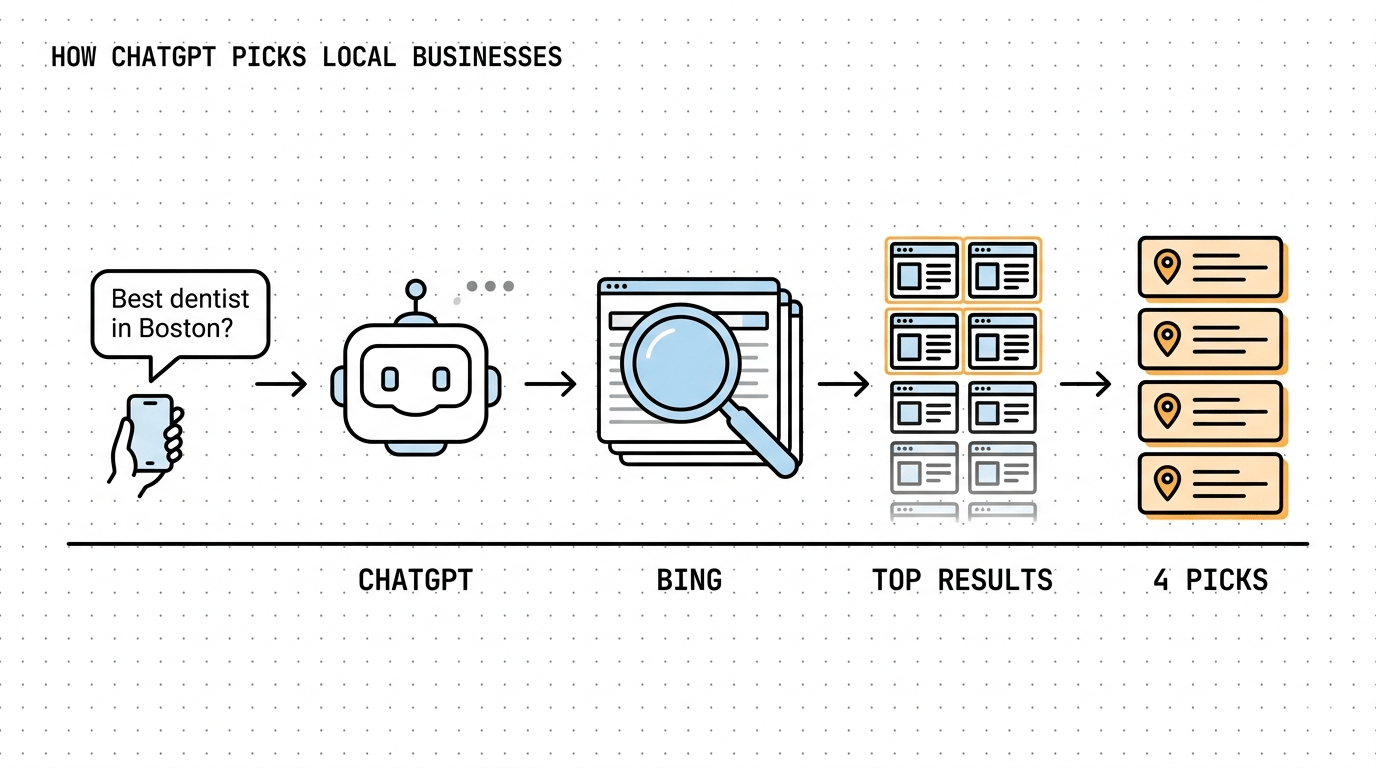
What is actually happening when ChatGPT recommends a local business
ChatGPT does not crawl the web in real time. It is trained on a fixed dataset, with a knowledge cutoff date, and most of what it "knows" about your business comes from that training pass.
For local queries specifically, ChatGPT does something extra. When you ask for a restaurant, dentist, plumber, or lawyer in a city, it usually triggers a live web lookup. As of early 2026, roughly 59% of ChatGPT searches that go to the live web are local-intent queries. That is the lookup pipeline most local SMBs need to understand.
The lookup itself runs on Bing. ChatGPT performs a Bing search for the query, takes the top twenty to thirty results, and uses its own logic to summarize and rank them into a short list of recommendations. This is the single most under-discussed fact in local GEO. If you want ChatGPT to surface you for a local query, your Bing footprint matters as much as your Google one.
That is also why ChatGPT references things you would not expect: Bing Places listings, Yelp pages, Trustpilot reviews, neighborhood blogs, "best of [city]" articles from local publications. If a source ranks well on Bing for your category and city, ChatGPT is going to see it.
AskMention runs the same kind of lookup ChatGPT runs, across seven AI platforms at once. Run a free scan to see exactly which sources are surfacing you today and which are surfacing your competitors instead.
The six signals that move local recommendations
Across the audits I have run for local SMBs over the last year, six signals show up again and again as the difference between businesses ChatGPT picks and businesses it ignores. In rough order of impact:
1. Google Business Profile completeness and category accuracy
Your Google Business Profile is the single most important local signal. It feeds Google's local data, which feeds the wider web, which feeds the training data ChatGPT was built on. It also feeds Bing's local index indirectly through citation networks.
The fixes are unglamorous and free. Claim the profile. Pick the most specific primary category (not "Dentist" but "Pediatric Dentist" if that is what you are). Fill every field: hours, services, insurance accepted, languages spoken, payment methods. Upload at least ten current photos. Write a description that uses the category term your customers actually search for.
If your GBP says one thing and your website says another, AI systems lower the confidence score and stop citing you. Consistency is the cheapest win in local GEO.
2. Multi-platform review volume and freshness
Reviews are the strongest trust signal in the AI recommendation stack. Industry data suggests businesses with reviews on Google, Yelp, and Facebook are about 2.8 times more likely to appear in AI search results than businesses with reviews on a single platform.
Quality matters more than quantity. A practice with 30 reviews averaging 4.8 stars consistently outperforms a practice with 200 reviews averaging 3.2. ChatGPT picks up the sentiment, not just the count.
What to do this week: pick the two review platforms that matter most for your category (Google + Yelp for restaurants, Google + Healthgrades for medical, Google + Avvo for legal) and set up a simple post-service text or email asking happy customers for a review. Respond to every review, positive or negative. Recency signals an active business.
3. Bing Places for Business
This one almost nobody does, which is why it is one of the highest-leverage signals available. Because ChatGPT's live lookup runs on Bing, your Bing Places listing matters in a way it never did when Bing was just "the other search engine."
Bing Places is free. You can import your Google Business Profile directly, which takes about three minutes. Verify the listing, add the same photos and descriptions you used on Google, and you are done. Most of your local competitors have not done this. That is the gap.
4. LocalBusiness schema, aligned with your GBP
Schema markup is how you hand a machine-readable summary of your business to every crawler that visits your site. For local businesses, the relevant types are LocalBusiness (or an industry-specific subtype like Dentist, Restaurant, Plumber) plus Service, FAQPage, and AggregateRating when you have reviews.
Audits suggest pages with proper schema markup are about 2.5 times more likely to appear in AI-generated answers. The catch: the schema has to match what is on your Google Business Profile. Different addresses, different phone numbers, different hours — all of that drops the AI's confidence and reduces citation rate.
If you are not sure what you have, AskMention auto-generates the schema markup you are missing and flags any inconsistencies with your GBP data.
5. Mentions in local press and "best of [city]" lists
ChatGPT cites editorial content heavily for local queries. Ask for restaurants in Toronto and you will see references to Eater and Time Out. Ask for plumbers in Phoenix and you will see local newspaper roundups and neighborhood-blog comparisons.
One inclusion in a high-authority local publication is worth more than three months of your own blog posts. Make a list of the five publications that cover your category in your city. Pitch them a story, an expert quote, a contributed article, or a customer success story. Cold pitches with a specific angle land more often than people expect, especially from local businesses.
6. On-page clarity: services, neighborhoods, insurance, hours
When ChatGPT explains why it recommended someone, it pulls those reasons from text on the recommended business's website. "Specializes in pediatric care" and "convenient hours for working parents" did not appear in those Boston dentist recommendations by accident. They came from clear, citeable copy on those practices' service pages.
What to write, in plain language: which neighborhoods you serve, which services you offer, which insurance you accept, which hours you keep, and what you are specifically known for. Skip the marketing adjectives. Write the way a human would describe you to a friend over coffee.
A worked example: the Boston dentist
Take a mid-pack family dentist in Boston that does not show up when I ask ChatGPT for a recommendation. Here is what is almost certainly happening and what to fix this quarter.
The practice has a Google Business Profile, but the primary category is set to "Dental Clinic" instead of "Family Dentist," and the description does not mention insurance. They have 60 reviews on Google averaging 4.6 stars — solid — but only 4 reviews on Yelp and none on Healthgrades. Their website has no schema markup. They have never been mentioned in Boston Magazine, the Boston Globe's healthcare coverage, or any neighborhood blog. There is no Bing Places listing.
In a quarter, this practice could realistically: tighten the GBP category, set up a review-request system aimed at Yelp and Healthgrades, claim Bing Places, add Dentist and FAQPage schema, write a service-area page that names every Boston neighborhood they serve and every insurance they accept, and pitch one local publication a "what to ask a family dentist about pediatric anxiety" expert column. Each one of those is a half-day of work. Together they would meaningfully change which dentists ChatGPT surfaces for Cigna families in Boston.
What does not move the needle
A few things people spend time on that produce almost no AI visibility lift:
- Paid ads. As of May 2026, OpenAI has not launched paid placements in ChatGPT answers. Google Ads spend does not buy you into AI recommendations. This is the part of the playing field that is genuinely level for small businesses.
- Keyword-stuffed location pages. "Best dentist Boston" repeated 40 times in the footer is the kind of thing that hurt Google ten years ago and never helped AI at all.
- Fake or incentivized reviews. AI models pick up sentiment patterns. A sudden burst of generic 5-star reviews reads as inauthentic and lowers the trust score.
- Content that only loads via JavaScript. AI crawlers prefer server-rendered HTML. If your services and locations only appear after a React render, much of it never makes it into the training data or the live lookup.
A 30-day local GEO plan
If you want a specific sequence, here is the four-week plan I would run for any local SMB starting from zero.
Week 1: baseline and quick wins. Audit your Google Business Profile end to end. Fix the category, fill every field, upload ten current photos. Claim Bing Places and import your GBP data. Run an AskMention scan so you have a baseline GEO score and a list of which AI platforms are mentioning you today.
Week 2: review system. Pick the two review platforms that matter for your category. Set up a one-line text or email that goes to every customer after service asking for a review on a specific platform. Respond to every review currently on your profiles. Aim for one new review per week per platform, sustainably.
Week 3: schema and on-page clarity. Add LocalBusiness schema (or the industry-specific subtype) to your homepage, aligned to your GBP. Add FAQPage schema to a page that answers the ten questions your customers actually ask. Rewrite your services and service-area pages in plain language: neighborhoods, hours, insurance, specialties. No adjectives.
Week 4: outreach. Pick one local publication that covers your category. Send one specific, useful pitch: an expert column, a contributed guide, a customer story. Even one placement here outperforms a month of your own blog posts. Then re-run the AskMention scan and compare against week one.
That is a meaningful quarter of work compressed into a month. Most local competitors will not do any of it.
The honest bottom line
ChatGPT does not pick local businesses randomly, and it does not pick them based on who pays the most. It picks the ones with the strongest, most consistent presence across the sources it actually reads: Bing Places, Google Business Profile, multi-platform reviews, schema-marked websites, and local editorial coverage.
None of those are expensive. All of them take time. The local businesses showing up in ChatGPT answers a year from now will be the ones that started compounding these signals this quarter.
If you have not measured where you stand yet, that is step one.
Related reading
- How ChatGPT Decides Which Businesses to Recommend — The general version of this article, covering the six factors that apply across all business types, not just local.
- How to Get Your Business Mentioned by ChatGPT — The 7-step GEO playbook for entity setup, schema, and the mentions that move the needle.
- What is GEO? A Guide to Generative Engine Optimization — The five pillars of AI visibility and the fundamentals behind everything above.
Written by
Founder of AskMention. Software engineer with 20+ years of experience building web products. Writes about GEO, AI search, and how small businesses can get recommended by ChatGPT and Gemini.
Find out if AI recommends your business
Run a free AI visibility audit across ChatGPT and Gemini — the 3 AI platforms covering ~95% of AI search.
See If AI Recommends You — Free