The Truth About llms.txt: What It Is, Who's Using It, and How to Add One
An honest guide to llms.txt. What it is, which AI providers actually use it, and the exact format you need, with a copyable template.
The first scan I ran for a friend's agency last month came back with a single ugly number. Zero out of 100 for llms.txt. He had a fast site, a clean blog, real traffic. None of it mattered for that score, because the file did not exist. We sat down on a Friday afternoon, drafted one in about forty minutes, uploaded it, and re-ran the scan. The score jumped to 90.
Here is the part nobody told him. As far as anyone can prove, that fix did not change a single AI recommendation. ChatGPT did not start mentioning his agency the next day. Perplexity did not suddenly cite his case studies. The score went up. The world stayed the same.
That is the strange position llms.txt sits in right now. Here is the honest take on what it is, who is actually using it, and whether you should bother.
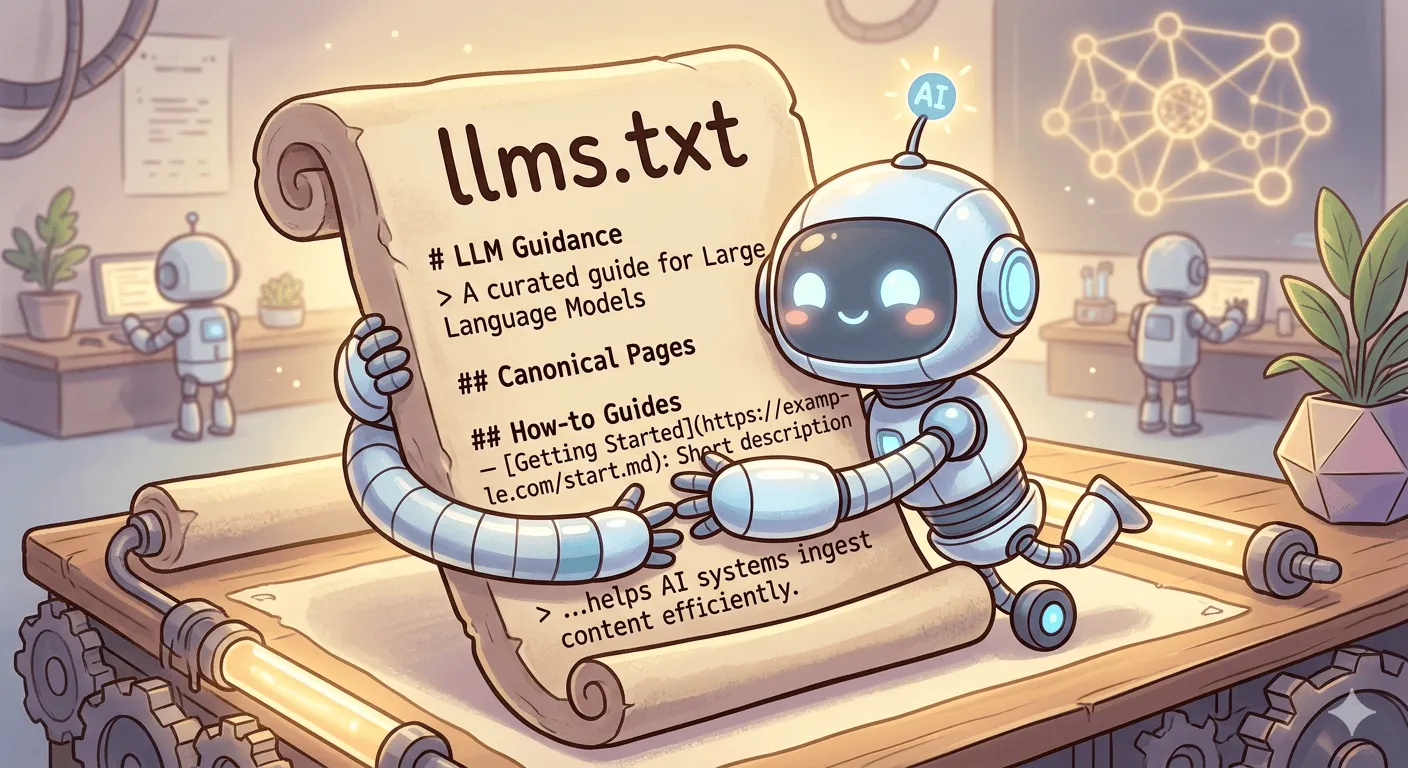
What llms.txt actually is
You probably know robots.txt. It is the small file at the root of your site that tells search crawlers which pages they can fetch and which they should leave alone. It has been around since 1994. Every serious site has one.
llms.txt is different. It does not control what gets crawled. It tells AI systems, in plain English, what your site is and which pages matter most. Think of it as the executive summary you would write for an intern who has thirty seconds before their first meeting.
The format is dead simple. A single Markdown file at yourdomain.com/llms.txt. One H1 with your site name. A short blockquote describing what you do. Then a few sections with bullet lists of your most important pages, each linked.
It was proposed by Jeremy Howard of Answer.AI on September 3, 2024. The full spec lives at llmstxt.org. It is a community proposal, not a W3C or IETF standard. There is no governing body, no enforcement, no penalty for ignoring it.
The pitch is intuitive. Modern AI systems pull context from web pages, but they have hard limits on how much they can fit in a single response. A homepage with twenty paragraphs of marketing copy plus a hundred linked pages is hard for a model to summarize. A llms.txt file gives it a curated map. Here is what we do, here are the ten pages that explain us best, here is how to find us.
It is, in short, a polite letter to AI.
Who is actually using it (the honest answer)
This is where most articles get it wrong. They say llms.txt is "the new SEO" or "what every business needs in 2026." Here is what is actually true.
On the publisher side, the big AI providers have all added llms.txt to their own documentation sites:
- Anthropic publishes one at docs.claude.com/llms.txt (about 147 KB)
- OpenAI publishes one at platform.openai.com/docs/llms.txt (about 25 KB)
- Perplexity publishes both docs.perplexity.ai/llms.txt and docs.perplexity.ai/llms-full.txt (the full version is about 896 KB)
- Google added one to its developer docs in December 2025
Each of those URLs returns a real file with real content. You can open them in your browser right now.
On the consumer side, the picture is much thinner. As of May 2026, no major AI platform has publicly confirmed that its crawlers actually read external llms.txt files. Google has been the most explicit. They have stated that the llms.txt files on their own sites are not used for search discovery or rankings, and that no AI system at Google currently treats it as an operational signal.
Independent research backs this up. An audit published in January 2026 looked at the websites that get cited most often in AI answers across ChatGPT, Perplexity, and Gemini. Many of those top-cited domains do not have llms.txt at all, and adding one did not appear to change citation rates.
So here is the honest read. Today, llms.txt is mostly a positioning move. The big providers are publishing their own, which is a coordination signal that the format may matter later. You cannot point to a confirmed case where adding one to your site made an AI cite you more often.
So why bother adding one?
If it is not a confirmed ranking signal, why is this article still telling you to make one? Five reasons, in order of how much I believe them.
First, it takes about thirty minutes and costs nothing. The downside is a single text file you have to update every few months.
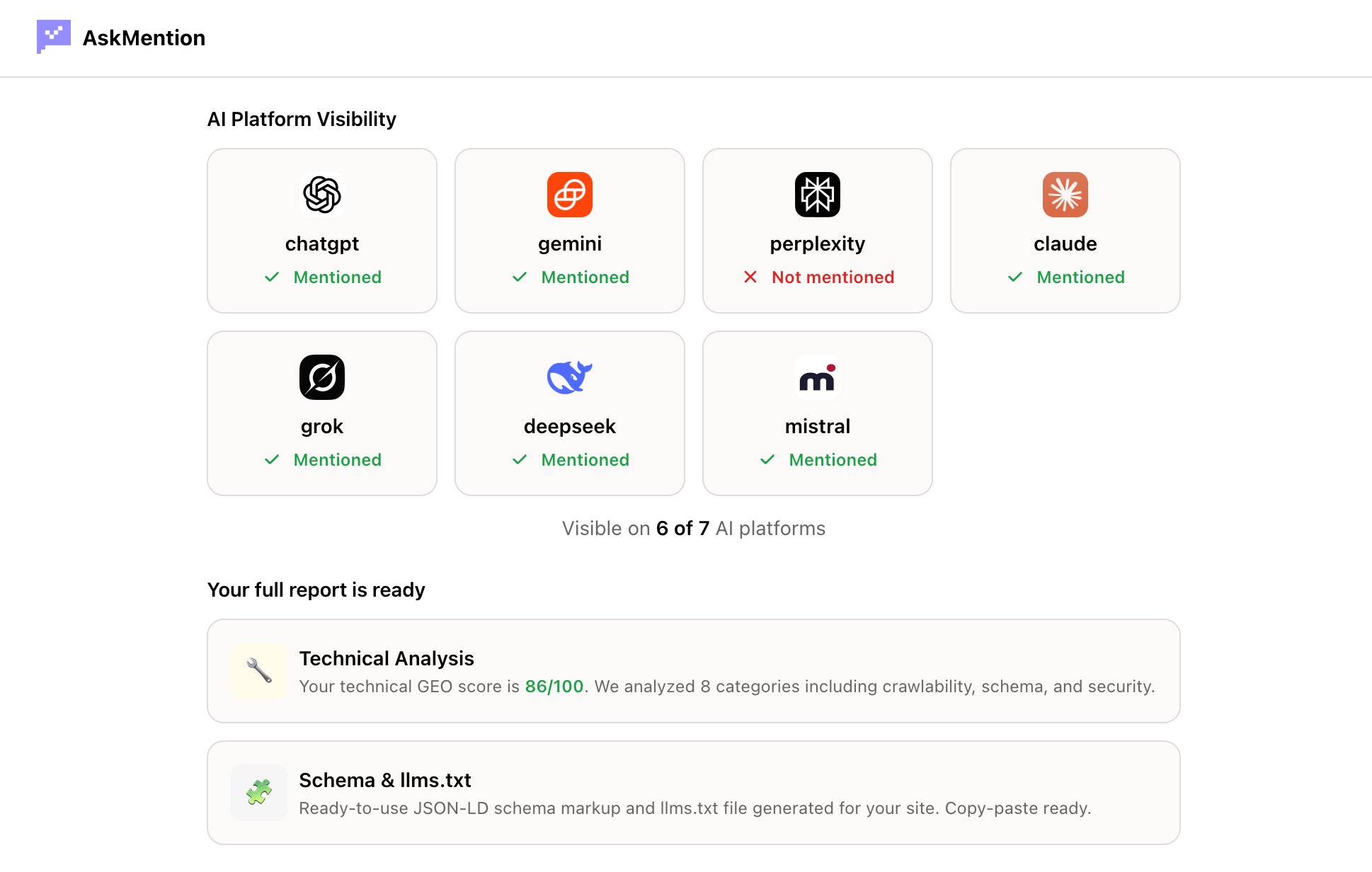
Second, some AI tools already check for it. AskMention's own scanner scores llms.txt as one of eight technical signals. There are other audit tools doing the same. If your customers run those scans on you, missing the file looks careless.
Third, when consumption happens, you are already there. The big providers publishing their own files is a soft commitment. If they start reading external files next year, the sites that already have one are first in line.
Fourth, writing one forces useful editorial discipline. Sit down and ask: what are the ten pages on my site that actually matter? Most teams have never made that list. The exercise is worth more than the file.
Fifth, you can do it in the time it takes to read the rest of this post and run a free AskMention scan afterward to confirm it landed.
The format, exactly
Per the spec at llmstxt.org, an llms.txt file has four building blocks. Only the first is required.
An H1 with your site name. This is the title of the document. One line, with a single hash:
# YourCompanyA blockquote with a one-line summary. This sits directly under the H1. It uses Markdown's blockquote syntax:
> Plain-English description of what you doFreeform Markdown sections. Use these to add context that does not fit a link list. A short company description, a pricing summary, a product positioning statement.
H2-delimited file lists. Each section uses a ## heading and contains Markdown links to your important pages, with optional notes:
## Features
- [AI Visibility Audit](https://example.com/features/audit): Free scan across ChatGPT, Gemini, Perplexity, Claude
- [Schema Generator](https://example.com/features/schema): One-click JSON-LD output
There is one special section name. If you call a section ## Optional, the spec says its links can be skipped when a shorter context is needed. Use this for nice-to-have pages that are not core to understanding your business.
What AskMention's scanner specifically rewards:
Our scanner uses a four-point rubric out of 100. Having the file at all earns 50 points. An H1 heading adds 10. A blockquote description adds another 10. Five or more links add 20 (fewer than five gets you 10). A maximum-quality file scores 100. A missing file scores 0 and produces a medium-severity finding in the audit.
A working template
Here is the structure AskMention uses for its own llms.txt, lightly trimmed. Copy this, change the names and links, and you have a real file ready to upload.
# YourCompany

> One-line description of what your company does

YourCompany helps [audience] [achieve outcome]. We do this by [unique mechanism]. Our customers are typically [specific persona].

## Features

- [Primary product](https://example.com/product): One-line benefit
- [Secondary product](https://example.com/secondary): One-line benefit
- [Free tool](https://example.com/free-tool): One-line benefit

## Pricing

- Free: [What is included]
- Pro ($X/month): [What is included]

## Links

- Homepage: https://example.com
- Pricing: https://example.com/pricing
- Privacy Policy: https://example.com/privacy

## Contact

- Founder: [Your name]
- Email: [email protected]
Two things to swap. Replace every example.com with your real domain. Replace every bracketed placeholder with a single specific sentence. Resist the urge to add bullets describing your "innovative solutions." The whole point is that this file is short, factual, and easy to summarize.
How to add it to your site, step by step
If you have never made one, here is the order I use.
1. List your five to fifteen most important pages. Open a blank document. Write down every page on your site that you would point a new customer at on day one. Stop at fifteen. If your list has thirty pages, your site has too many pages, and you are about to find that out.
2. Write a one-line value-prop description. This is the blockquote. It is the hardest line in the file. "We help small clinics get found in AI search results" is a good blockquote. "Innovative AI-powered solutions for healthcare professionals" is not.
3. Group your pages into sections. Common groupings: Features, Pricing, Resources, Case Studies, Contact. Two to four sections is typical. Each section gets a ## heading and a bullet list of links with a one-line note.
4. Save the file as llms.txt at your web root. It has to load when someone visits yourdomain.com/llms.txt. Not in a subdirectory. Not behind a login. If you use WordPress, drop it in the root directory of your hosting. If you use Webflow, you may need a redirect rule.
5. Verify it loads, then update it when you launch new content. Open yourdomain.com/llms.txt in a private browser window. If it downloads instead of displays, you have a content-type issue. Fix it. Then put a calendar reminder to revisit the file every quarter.
Common mistakes
Five things I have seen people get wrong:
- Putting it in a subdirectory instead of the root.
yourdomain.com/llms.txtis the only correct location. Subdirectories do not count. - Saving as
.htmlor.mdinstead of.txt. The file extension matters for content-type. Keep it as plain text with a.txtextension. - Linking 100+ pages. This defeats the entire purpose. The file is supposed to be the curated short list. Cap yourself at 20 links unless you have a very large catalog. Use the
## Optionalsection for the second tier. - Writing marketing copy in the description. The blockquote is for facts. Save the persuasive language for your homepage. AI systems are looking for clarity, not punch.
- Setting it and forgetting it. Treat it like a sitemap. When you launch a new page that matters, add the link.
How to test it
Two checks worth doing.
The first is the basic load test. Open yourdomain.com/llms.txt in a private browser window. The file should display as plain text, not download as a file. If it downloads, your server is sending the wrong content-type header and you need to fix that in your hosting config.
The second is a scoring check. Run a free AskMention scan and look at the technical analysis section. We grade your llms.txt against the four-point rubric described above. You can see exactly which elements you are missing.
The bottom line
llms.txt is not a confirmed AI ranking signal in 2026. Google has said it is not used for search. Independent audits show top-cited domains often skip it.
What it is: a thirty-minute, free way to align with what every major AI provider is already doing on their own sites. The exercise of writing it is more valuable than the file itself.
If you have not made one yet, today is a good day. Run a scan afterward to make sure it landed.
Related reading
Written by
Founder of AskMention. Software engineer with 20+ years of experience building web products. Writes about GEO, AI search, and how small businesses can get recommended by ChatGPT, Gemini and Perplexity.
Find out if AI recommends your business
Run a free AI visibility audit across ChatGPT, Gemini and Perplexity — the 3 AI platforms covering ~95% of AI search.
See If AI Recommends You — Free